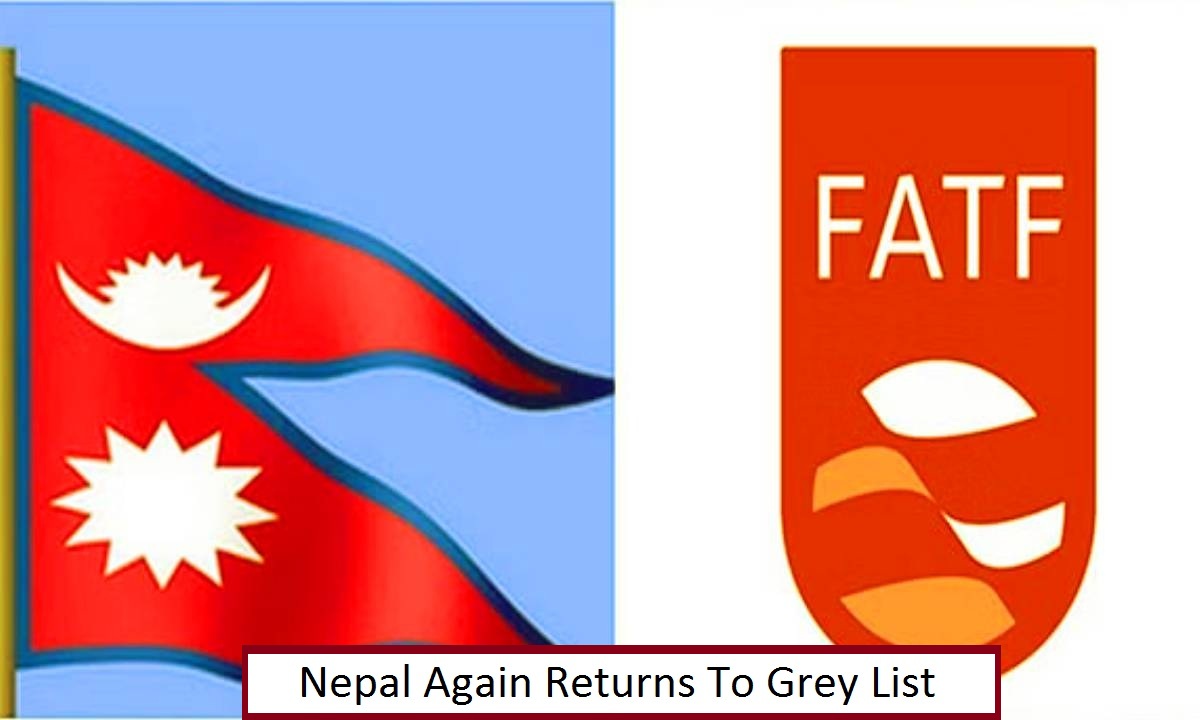
 Banking Khabar / Nepal has once again remained on the ‘Grey List’ of the Financial Action Task Force (FATF), the international watchdog responsible for combating financial crimes.
The country continues to face increased global monitoring due to insufficient progress in implementing reforms required to control money laundering and terrorist financing.
Being placed on the FATF Grey List is not a sanction or a ban against a country. Instead, it indicates that a nation has certain strategic weaknesses in its financial system and requires enhanced monitoring to address those gaps.
For Nepal, the Grey List status is not a new challenge. The country has faced similar concerns in the past. Although Nepal has introduced legal reforms, strengthened regulatory frameworks, and made several commitments, weaknesses in practical implementation have resulted in continued international scrutiny.
The key challenge now is not merely drafting laws but demonstrating effective enforcement to restore confidence in Nepal’s financial system.
Laws Established, But Implementation Remains a Challenge
Nepal has introduced various laws to prevent money laundering and established regulatory institutions to oversee compliance.
Banks and financial institutions have been instructed to implement customer identification procedures (KYC), suspicious transaction reporting mechanisms, and risk management frameworks.
However, FATF evaluations focus not only on the existence of laws but also on their effectiveness and measurable outcomes.
Nepal has faced criticism over limited effectiveness in identifying suspicious transactions, conducting investigations, filing cases, and taking action against offenders.
International assessments have highlighted the need to strengthen the capacity of investigation agencies, improve coordination among government bodies, and enhance the efficiency of judicial processes related to financial crimes.
Banking Sector Faces Increased Scrutiny
Nepal’s banking system is directly linked with FATF compliance standards. Banks and financial institutions have been investing significantly to meet international requirements related to customer verification, risk assessment, and suspicious transaction monitoring.
However, continued placement on the Grey List may lead international banks and financial institutions to adopt greater caution while dealing with Nepal.
Cross-border payments, correspondent banking relationships, and international trade transactions could face additional scrutiny and compliance requirements. This may increase transaction costs and create further challenges for businesses and financial institutions involved in global transactions.
Impact on Foreign Investment Confidence
When foreign investors evaluate a market, they consider not only political stability and economic conditions but also financial transparency and regulatory credibility.
Nepal’s presence on the FATF Grey List may create perceptions of higher financial risk, potentially influencing foreign investment decisions.
This comes at a time when Nepal is already facing slower economic activity, weak private sector confidence, and limited investment expansion. Any negative impact on the country’s international financial image could add further pressure to the economy.
Remittance Flow Unlikely to Stop, But Monitoring May Increase
Nepal’s Grey List status does not mean remittance flows will stop. However, international financial institutions may introduce stricter monitoring measures as part of risk management practices.
This could make international money transfers slightly more complex, particularly if additional verification procedures are introduced.
Nepal will need to take stronger measures to control informal financial channels and ensure greater transparency in remittance-related transactions.
Beyond Exiting the Grey List: Building a Stronger Financial System
For Nepal, the goal should not only be to exit the FATF Grey List but also to build a stronger, more transparent, and internationally trusted financial system.
Meeting global standards on anti-money laundering and combating terrorist financing requires effective cooperation among the government, Nepal Rastra Bank, investigation agencies, security bodies, and judicial institutions.Nepal has repeatedly made commitments in the past, but the international community is now looking for measurable results rather than promises.
A Warning and an Opportunity for Reform
Remaining on the FATF Grey List does not indicate that Nepal’s financial system has failed. Several countries have successfully improved their systems and exited the list through stronger enforcement and institutional reforms.
Nepal can also return to a normal status by improving implementation, strengthening investigative capacity, and increasing financial transparency.However, achieving this requires political commitment, stronger institutions, and practical reforms—not just policy announcements and reports.
The FATF Grey List should be viewed both as a warning and an opportunity. If Nepal uses this moment to accelerate reforms, it could strengthen its banking system and enhance international credibility.But delays in addressing these weaknesses could eventually affect not only the financial sector but also the broader economy.