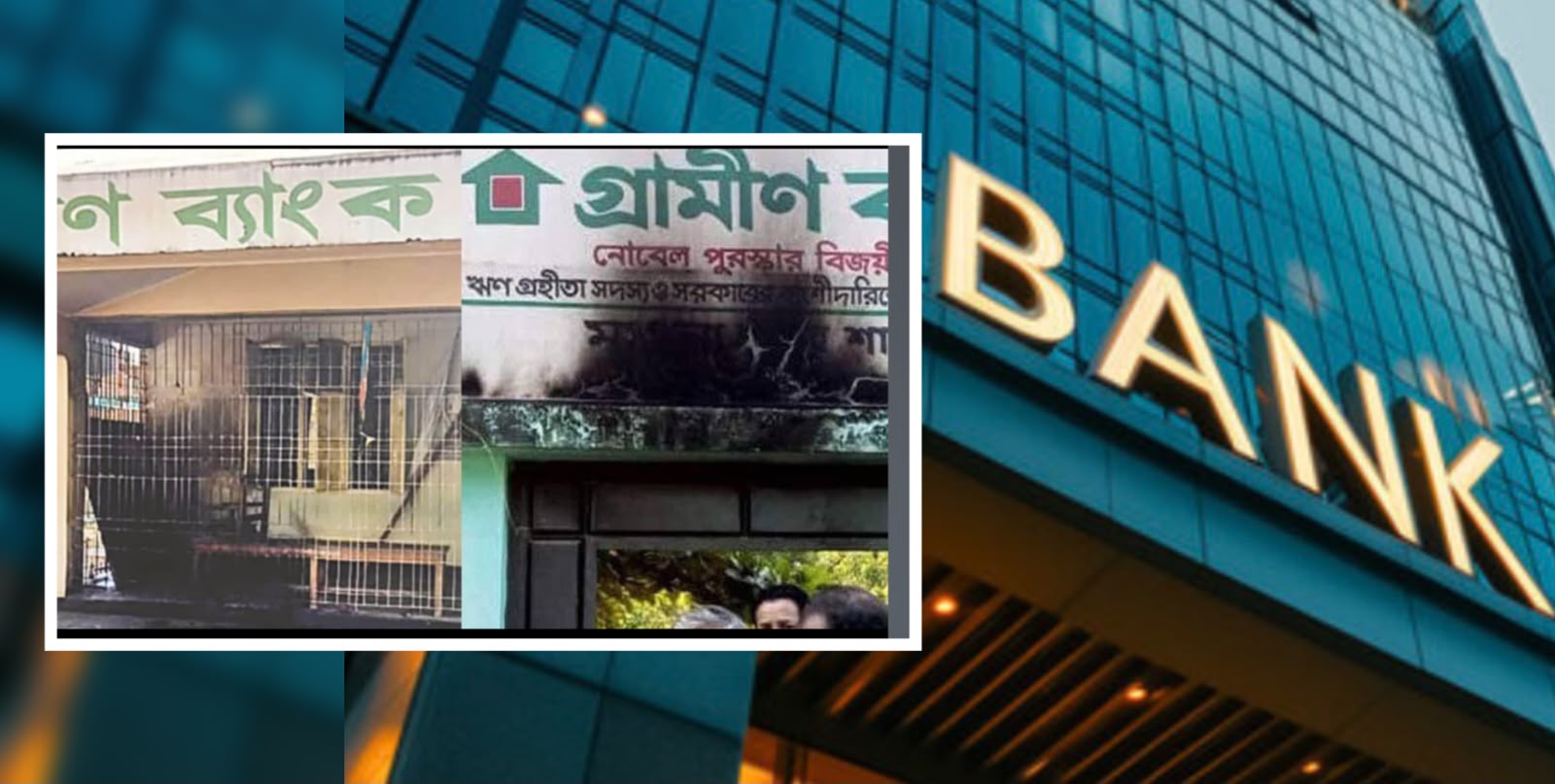
 Banking Khabar / Political conflict takes a toll on Grameen Bank as 97 branches and offices face arson and vandalism, putting the financial security of more than 10 million members at risk.
Attacks on banks and financial institutions have been escalating in Bangladesh, with the world-renowned microfinance institution Grameen Bank emerging as a particular target. Branches and offices of the institution have reportedly been subjected to arson, vandalism and looting amid recent incidents linked to political conflict.
According to details covering the period from November 10 to 23, a total of 97 Grameen Bank branches and offices came under attack. Petrol bombs were reportedly thrown at some offices, while others were set on fire or vandalised. Computers, CCTV systems, furniture and important documents were also destroyed. In some locations, attempts were reportedly made to break into bank vaults.
At the Kashiani branch in Gopalganj district, around 40 sacks of vouchers and old documents were reportedly burned. The incident has raised concerns not only about the bank’s daily operations but also about the management and preservation of financial records belonging to borrowers and customers.
Why Has Grameen Bank Become a Target?
The attacks on Grameen Bank appear to be linked to Bangladesh’s recent political developments. The bank’s founder, Muhammad Yunus, is a Nobel Peace Prize laureate. He became the chief adviser to Bangladesh’s interim government in 2024 following the fall of Sheikh Hasina’s government.
International media reports have suggested that political resentment towards Yunus may be one of the factors behind the attacks on Grameen Bank. The Bangladeshi government has accused supporters of former Prime Minister Sheikh Hasina’s Awami League of involvement in the attacks. However, the identities of those responsible and the existence of political direction behind all the incidents have not been independently established.
Financial Transactions of More Than 10 Million Members at Risk
Grameen Bank is not an ordinary banking institution. It is widely recognised as one of the world’s leading examples of microfinance, with a model focused on providing small loans to low-income people, rural communities, women and small entrepreneurs to help them participate in economic activities.
The bank has approximately 10.6 million members and employs around 21,000 people. According to publicly reported figures, members’ deposits stand at approximately 250 billion Bangladeshi taka, while outstanding loans exceed 190 billion taka.
In terms of ownership, borrowers hold a 90 percent stake in the bank, while the government owns the remaining 10 percent. This means that the institution is largely owned by its own borrower-members.
The attacks on its branches have caused damage beyond buildings and physical assets. They have also raised concerns about customers’ deposits, loan records, instalment payments and the continuity of routine financial transactions.
Reports also indicate that the bank has suspended interest calculations on outstanding loans at some branches that have been unable to operate because of the attacks.
Serious Questions Over Banking Security
The incidents in Bangladesh demonstrate that the security of banks and financial institutions cannot be ensured solely through police deployment and security guards. Political instability, social tensions and public hostility towards institutions can also pose serious threats to the financial system.
Arson at bank offices can undermine public confidence in savings and deposits. The destruction of loan records can create difficulties in debt recovery and transaction verification. It may also disrupt the economic activities of people in rural communities who depend on small loans to operate their businesses.
Meanwhile, Bangladesh’s cybersecurity authorities have reportedly warned banks and financial institutions to remain alert to potential cyberattacks involving artificial intelligence (AI). This highlights the need to protect the banking system against both physical and digital threats.
A Lesson for Nepal’s Banking Sector
The attacks on Grameen Bank in Bangladesh are also a matter of concern for Nepal. Millions of people in Nepal are connected to financial services through banks, microfinance institutions and cooperatives.
When banks and financial institutions are attacked in the name of political or social dissent, the consequences are not limited to their management or operators. Ordinary people’s savings, loans, employment and local economic activities can also be affected.
Therefore, physical security, backup systems for digital records, crisis management and measures to maintain depositors’ confidence should remain key priorities for financial institutions.
The developments in Bangladesh raise an important question: when political conflict spills over into the banking sector, is it only the institution’s management that bears the cost, or do ordinary people who depend on small savings and loans also end up paying the price?
Political conflict takes a toll on Grameen Bank as 97 branches and offices face arson and vandalism, putting the financial security of more than 10 million members at risk
Attacks on banks and financial institutions have been escalating in Bangladesh, with the world-renowned microfinance institution Grameen Bank emerging as a particular target. Branches and offices of the institution have reportedly been subjected to arson, vandalism and looting amid recent incidents linked to political conflict.
According to details covering the period from November 10 to 23, a total of 97 Grameen Bank branches and offices came under attack. Petrol bombs were reportedly thrown at some offices, while others were set on fire or vandalised. Computers, CCTV systems, furniture and important documents were also destroyed. In some locations, attempts were reportedly made to break into bank vaults.
At the Kashiani branch in Gopalganj district, around 40 sacks of vouchers and old documents were reportedly burned. The incident has raised concerns not only about the bank’s daily operations but also about the management and preservation of financial records belonging to borrowers and customers.
Why Has Grameen Bank Become a Target?
The attacks on Grameen Bank appear to be linked to Bangladesh’s recent political developments. The bank’s founder, Muhammad Yunus, is a Nobel Peace Prize laureate. He became the chief adviser to Bangladesh’s interim government in 2024 following the fall of Sheikh Hasina’s government.
International media reports have suggested that political resentment towards Yunus may be one of the factors behind the attacks on Grameen Bank. The Bangladeshi government has accused supporters of former Prime Minister Sheikh Hasina’s Awami League of involvement in the attacks. However, the identities of those responsible and the existence of political direction behind all the incidents have not been independently established.
Financial Transactions of More Than 10 Million Members at Risk
Grameen Bank is not an ordinary banking institution. It is widely recognised as one of the world’s leading examples of microfinance, with a model focused on providing small loans to low-income people, rural communities, women and small entrepreneurs to help them participate in economic activities.
The bank has approximately 10.6 million members and employs around 21,000 people. According to publicly reported figures, members’ deposits stand at approximately 250 billion Bangladeshi taka, while outstanding loans exceed 190 billion taka.
In terms of ownership, borrowers hold a 90 percent stake in the bank, while the government owns the remaining 10 percent. This means that the institution is largely owned by its own borrower-members.
The attacks on its branches have caused damage beyond buildings and physical assets. They have also raised concerns about customers’ deposits, loan records, instalment payments and the continuity of routine financial transactions.
Reports also indicate that the bank has suspended interest calculations on outstanding loans at some branches that have been unable to operate because of the attacks.
Serious Questions Over Banking Security
The incidents in Bangladesh demonstrate that the security of banks and financial institutions cannot be ensured solely through police deployment and security guards. Political instability, social tensions and public hostility towards institutions can also pose serious threats to the financial system.
Arson at bank offices can undermine public confidence in savings and deposits. The destruction of loan records can create difficulties in debt recovery and transaction verification. It may also disrupt the economic activities of people in rural communities who depend on small loans to operate their businesses.
Meanwhile, Bangladesh’s cybersecurity authorities have reportedly warned banks and financial institutions to remain alert to potential cyberattacks involving artificial intelligence (AI). This highlights the need to protect the banking system against both physical and digital threats.
A Lesson for Nepal’s Banking Sector
The attacks on Grameen Bank in Bangladesh are also a matter of concern for Nepal. Millions of people in Nepal are connected to financial services through banks, microfinance institutions and cooperatives.
When banks and financial institutions are attacked in the name of political or social dissent, the consequences are not limited to their management or operators. Ordinary people’s savings, loans, employment and local economic activities can also be affected.
Therefore, physical security, backup systems for digital records, crisis management and measures to maintain depositors’ confidence should remain key priorities for financial institutions.
The developments in Bangladesh raise an important question: when political conflict spills over into the banking sector, is it only the institution’s management that bears the cost, or do ordinary people who depend on small savings and loans also end up paying the price?