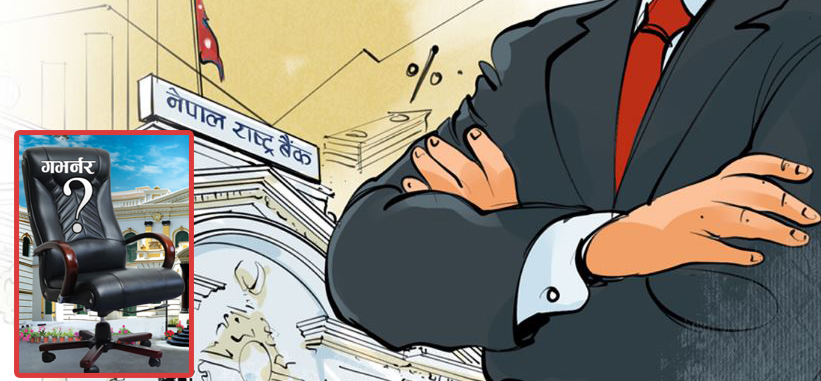
Banking News/ It has been a month since the post of Governor at Nepal Rastra Bank became vacant, but the appointment process has remained stuck in a loop. The government’s failure to appoint a new Governor is beginning to raise questions about the credibility of its decision-making. The position has remained unfilled since Chaitra 24 (April 6), with Deputy Governor Dr. Neelam Dhungana currently serving as the Acting Governor. Despite a month having passed, the government has not been able to appoint a new Governor.
According to legal provisions, a new Governor should be appointed and publicly announced one month before the term of the outgoing Governor ends. Section 25 of the Nepal Rastra Bank Act, 2058 (2002 AD) states:
“The Government of Nepal shall normally appoint a Governor under this Act and publicly announce the appointment at least one month before the current Governor’s term expires.”
However, neither was a timely appointment made, nor was any notice published. The race for Governor has been heavily influenced by political access and favoritism.
Throughout the past month, major coalition parties—Nepali Congress and CPN-UML—have been lobbying intensely to get their candidates appointed, yet the two-thirds majority government has failed to finalize the appointment.
Central Bank Paralyzed as Politics Takes Over

Although Nepal Rastra Bank was established as an autonomous institution, it has repeatedly faced political interference—whether in Governor appointments or operational decisions. Globally, central banks are expected to be free from political influence. In neighboring India, two central bank Governors resigned due to government interference. But in Nepal, such intervention is increasing, reducing the institution’s dignity and undermining its autonomy. Political meddling has significantly weakened the capacity of the central bank, which is supposed to be the backbone of the economy.
At the very least, the next Governor should be selected based on merit, not political clout. Unfortunately, the government has ignored legal provisions in delaying the appointment of the 18th Governor.
The absence of a Governor has already stalled the third quarterly review of the monetary policy. This delay is expected to negatively affect price stability and the country’s balance of payments. While a new Governor is expected to take crucial steps toward economic stabilization, the prolonged delay is already disrupting the financial system.
Even though Nepali Congress and CPN-UML have reportedly agreed on a candidate, the appointment is still delayed. The Rastra Bank usually prepares for a monetary policy review at the end of each quarter, led by its Economic Research Department. Currently, however, both the Governor position and the Executive Director of the department are vacant—the latter having resigned but not had his resignation accepted.
Dr. Gunakar Bhatta, the Executive Director of the department and a candidate for Governor backed by Nepali Congress, submitted his resignation, which Acting Governor Dr. Dhungana has not yet accepted. Dr. Dhungana, herself an aspirant for the Governor position, reportedly sees Bhatta as a strong rival, resulting in tensions that are affecting key tasks like the monetary policy review.
Endless Rotation for the Governor’s Seat

The race for Governor began three months before outgoing Governor Maha Prasad Adhikari’s term expired. Candidates started lobbying political power centers, presenting themselves as the right person to stabilize the economy. The list of contenders included current and former Deputy Governors, current and retired Executive Directors of the central bank, economists, administrators, and government advisors close to the ruling coalition.
Eventually, the selection process reached Dr. Bishwo Paudel, a member of the Governor Recommendation Committee.
During this period, on Falgun 27 (March 10), the age limit provision for appointments was removed by amending the criteria for appointing officials to public bodies under the Ministry of Finance. This change was seen as aligning with the interests of certain power groups. However, a writ petition was filed at the Supreme Court against this amendment on Chaitra 29 (April 11), and on Baisakh 3 (April 15), the Court issued a show-cause order, reinstating the 65-year age limit for the Governor position.
On Chaitra 11 (March 24), a recommendation committee was formed with Deputy Prime Minister and Finance Minister Bishnu Prasad Paudel as chair, and former Governors Bijaya Nath Bhattarai and Dr. Bishwonath Paudel as members. On Chaitra 25 (April 7), Deputy Governor Dr. Neelam Dhungana Timsina was assigned as Acting Governor.
On Baisakh 5 (April 17), Dr. Gunakar Bhatta resigned as Executive Director, backed by the Nepali Congress. On Baisakh 9 (April 21), committee member Bijaya Nath Bhattarai also resigned, citing inactivity of the committee. On Baisakh 17 (April 29), former Governor Maha Prasad Adhikari was appointed to fill the vacancy on the committee. However, on Baisakh 28 (May 10), a writ petition was filed at the Supreme Court against Adhikari. That same day, Dr. Bishwonath Poudel also resigned from the committee.
Endless Watching and Waiting
Even before the Governor’s post was vacated, potential candidates began resigning from their posts. Dr. Prakash Kumar Shrestha, Executive Director of the Rastra Bank and a member of the National Planning Commission, resigned on Falgun 18 (March 1), although news of his resignation only came out in late Chaitra.
Next, Nabil Bank CEO Gyanendra Dhungana resigned, effective from Chaitra 10 (March 23), just before the Governor’s post became vacant on Chaitra 24. Then came Dr. Gunakar Bhatta’s resignation on Baisakh 5. However, Acting Governor Dhungana has not accepted it, creating complications.
Following this, recommendation committee member Bijayanath Bhattarai resigned on Baisakh 9. When Bhatta’s resignation was not accepted, the Nepali Congress proposed Dr. Bishwonath Paudel for Governor. Consequently, Paudel also resigned from the committee on Baisakh 28.
Now the recommendation committee is once again incomplete. The government is first obligated to reconstitute the committee, only then can the names of three candidates be forwarded to the Cabinet for final selection.
Thus, those who had long dreamt of becoming Governor now find themselves simply watching from the sidelines, waiting endlessly.