Banking Khabar / As the year 2082 draws to a close, Nepal reflects on a period marked by deep wounds as well as hard-earned lessons. Time moves forward with the turning of calendar pages, but the transition into a new year carries far greater meaning than a simple change in dates.
The arrival of a new year serves as a moment of accountability, an opportunity to measure how well a nation has absorbed the lessons of its past and how prepared it is to shape its future. In this light, 2082 stands as a year of profound pain and reflection.
Over the past year, Nepal endured significant turmoil, with conflict and unrest leaving visible scars across the country. What unfolded was not merely a series of incidents, but a turbulent clash of intentions and circumstances that pushed the nation into a period of blood-war and uncertainty.
The remnants of a shattered national heritage still linger in the air, a stark reminder of the turmoil Nepal has endured. Yet, despite the weight of those dark and oppressive moments, the country is slowly charting a course toward hope and renewal.
Emerging from a period that once felt suffocating, Nepal now finds itself reaching for new possibilities. The wounds of 2082 remain deep, but the nation has chosen resilience over despair, turning to democratic processes to rebuild its future.
While election outcomes may serve as numbers in political calculations, their true significance lies beyond arithmetic. They represent a collective commitment to shaping a better tomorrow, an ambitious national effort to secure a brighter, more stable future for both the present generation and those to come.
There is no room for escape or avoidance in the face of this challenge, no excuse to tire or give up. We must honor the sacrifice, blood, and unwavering determination of the Gen-Z generation on Bhadra 23 and 24 of 2082. Only through this will the spirits of those lost on that fateful day, whose sacrifices symbolized the nation’s future, find peace and joy in the dawn of prosperity.
Let’s take a moment to reflect: the future of our nation began to take root from the very ashes of its past. The year 2082 kicked off with the collapse of the royalist movement in Tinkune, Kathmandu, on Chaitra 15, 2081. This event came nearly three months after the CPN-UML and Nepali Congress had formed a government. However, the downfall of that government, led by the two largest parties in parliament at the time, marked the true beginning of 2082.
Amid political tensions and the devastation caused by the monsoon rains, the first nine months of the Oli government passed. During this time, the government sought to push through several controversial bills, including the Social Media Bill and the Counter-Espionage Bill, sparking growing disputes between political parties.
Despite the dominance of the largest and second-largest political parties in parliament, the government was led by the third-largest party, mired in coalition deals and constant power struggles. However, this arrangement was short-lived, as coalition partners kept shifting. In the end, neither the government nor the system could sustain itself.
Frustrated by this political maneuvering and the endless power-sharing, the new generation took to social media to voice their anger, disillusionment, hopes, and dreams. It became their primary outlet, as the government showed little interest in the concerns of the people, with Maitighar Mandala a hub of public sentiment feeling increasingly distant from the halls of power, like Singha Durbar, which seemed worlds away.
Political parties have long used the voice, sentiments, and aspirations of the people as a means to climb to power, only to discard them once they’ve reached their goal. In this environment, two dominant parties joined forces to form a government, leaving almost no opposition in parliament. Those few opposition voices that remained appeared weak and overshadowed by the ruling coalition. In this context, the government was formed not by popular will, but through a deal of power-sharing between the parties. However, this time, the people took control through the election.
This time, the electorate entrusted their hopes to a new party and fresh faces. The Rastriya Swatantra Party received nearly two-thirds of the vote, sending a clear message to ‘go and work’ for the next five years. In contrast to the past, when parties merely joined forces to ‘go and work’ among themselves, this election marked a significant shift. It reflected the growing discontent over leadership transitions within the UML and the generational changes brewing within the Nepali Congress.
The political maneuvering of the former President had already stirred up turmoil within the UML, but Oli attempted to quell the unrest by positioning himself as the party chairman. Meanwhile, the government began blocking certain social media platforms, marking a pivotal moment in the eventual downfall of the Oli administration.
In an effort to control online discourse, the government sought to bring international social media companies under the state’s legal framework. However, the new generation, raised in the digital age, had already ignited an internet revolution, outpacing the government’s efforts to stifle free expression. For the youth, social media was not just a tool, it was everything, a space for self-expression and connection, and the government’s attempts to control it became a source of friction.
This generation, largely disengaged from traditional politics and its corruption, found itself pushed to action by the arrogance of the ruling class. On Bhadra 23, 2082, the youth took to the streets at Maitighar Mandala, protesting against the ‘nepo-baby’ discrimination of political leaders. What started as a peaceful march soon escalated into violence, and by the time those young voices reached the parliament building, the streets of Kathmandu were soaked in blood.
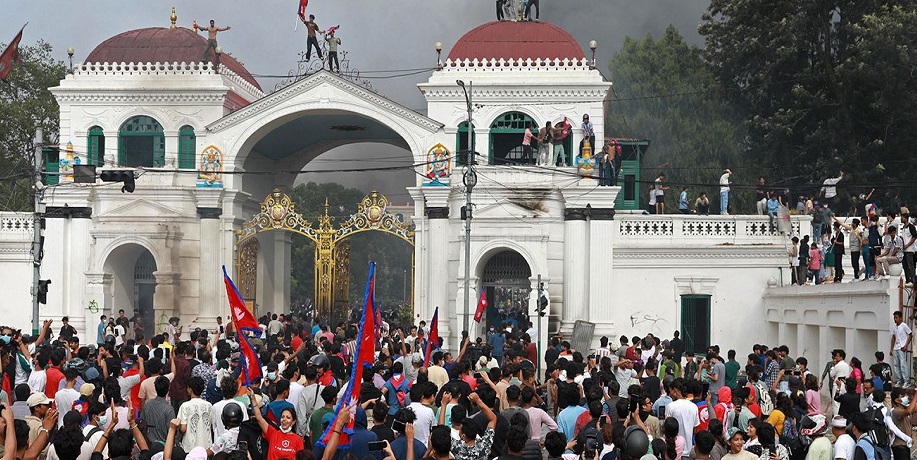
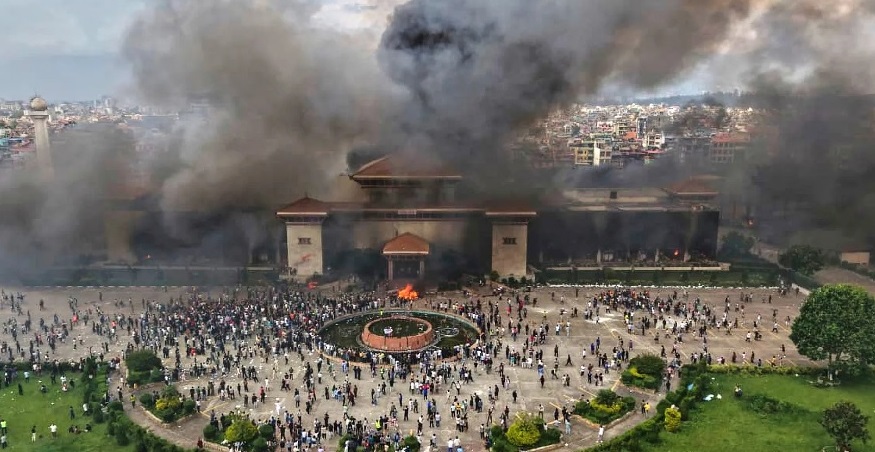
More than 76 young people reportedly lost their lives, and the following day, Bhadra 24, saw widespread destruction as key national institutions—including the Parliament building, Singha Durbar, and the Supreme Court were reduced to ashes. The collapse of the government led by major political forces followed within 24 hours, plunging the country into a prolonged period of uncertainty. With no functioning parliament, executive authority, or active judiciary, Nepal faced an unprecedented institutional vacuum that left a lasting impact on its political history.
In the aftermath, former Chief Justice Sushila Karki was appointed as Nepal’s first female interim prime minister on Bhadra 28. Parliament was dissolved, and fresh elections were scheduled for Falgun 21, 2082. However, political instability continued as internal party divisions deepened and leadership struggles intensified across major parties.
Within the Nepali Congress, demands for generational change culminated in a special general convention, bringing the “Gagan generation” into leadership roles, though legal disputes over legitimacy remained unresolved. Meanwhile, Pushpa Kamal Dahal ‘Prachanda’ consolidated several fragmented communist factions, forming a unified “Nepali Communist Party” in an effort to counter leadership transitions and internal dissent.
The political landscape underwent a dramatic shift as new forces emerged. The Rastriya Swatantra Party (RSP), which had entered parliament with limited seats in 2079, rose to prominence, reshaping Nepal’s traditional political order. Popular dissatisfaction with established parties translated into strong support for new leadership figures, including Kathmandu Mayor Balen Shah, who entered national politics after resigning from office and was projected as a prime ministerial candidate.
The elections held on Falgun 21 delivered a decisive rejection of established parties. The Nepali Congress suffered one of its worst defeats despite promoting a new leadership line, while the CPN-UML also experienced significant losses. Several regional parties in Madhesh were nearly wiped out, and independent political figures such as Harka Sampang gained visibility in national politics.
Following the election, a new government was formed with Balen Shah assuming the role of prime minister, as pledged by the RSP. Within hours of taking office, several high-profile arrests were made, including former Prime Minister K.P. Sharma Oli and Home Minister Ramesh Lekhak. Arrest warrants were also issued against senior Congress leader Sher Bahadur Deuba and his wife, with multiple corruption and governance-related investigations reopened.
The new administration also announced a sweeping probe into the assets of all senior officials since 2046, signaling a strong push toward accountability and governance reform. While early steps toward reform have been initiated, analysts note that public expectations remain extremely high, leaving little room for delay or failure.
Despite ongoing challenges, the government has introduced initial reforms aimed at improving governance and fulfilling electoral promises. However, political observers caution that rising public frustration could quickly resurface if reforms fail to match expectations.
Overall, 2082 is being described as a watershed year in Nepal’s political history one that dismantled long-standing power structures, elevated new political forces, and fundamentally reshaped the country’s democratic landscape. It stands as a turning point that erased parts of the past while simultaneously writing the beginning of a new political era.