 Banking Khabar / Nepal’s oldest and largest academic institution, Tribhuvan University, has found itself in an extraordinary battle, not to expand education or improve infrastructure, but to reclaim and protect its own land.
What initially appeared to be a routine administrative review has now exploded into a nationwide controversy involving banks, business houses, public institutions and allegations of long-standing misuse of public property. The revelations have triggered serious debate over institutional accountability, political influence and the failure of state mechanisms to safeguard public assets.
Vast University Land Outside Direct Control
A few months ago, Tribhuvan University launched a special investigation to determine the real status of the land and immovable properties registered under its ownership. According to university sources, a significant portion of land acquired over decades through donations, acquisitions and government decisions is no longer under the university’s effective control.
During the investigation, officials reportedly discovered that some university land had been occupied by private structures, while other portions were being used by government offices, financial institutions and commercial establishments.
The findings prompted the university to prepare an internal report and initiate steps to direct entities occupying the land to vacate the premises.
Auditor General’s Report Opened the Floodgates
The issue gained national attention after the 63rd report of Nepal’s Office of the Auditor General highlighted the need to protect land owned by Tribhuvan University.
The controversy deepened further after a detailed study conducted by the university’s Land and Property Investigation Committee revealed the scale of the issue within the Kathmandu Valley.
According to the report, the university and its affiliated bodies possess full ownership of approximately 13.332 million square meters of land. Another 999,000 square meters fall under usufruct rights, while nearly 653,000 square meters have reportedly been encroached upon.
In total, the university is linked to nearly 14.984 million square meters of land — an extraordinarily large public asset by any standard.
Banking Sector Dragged Into Controversy
The involvement of banks has made the controversy even more explosive.
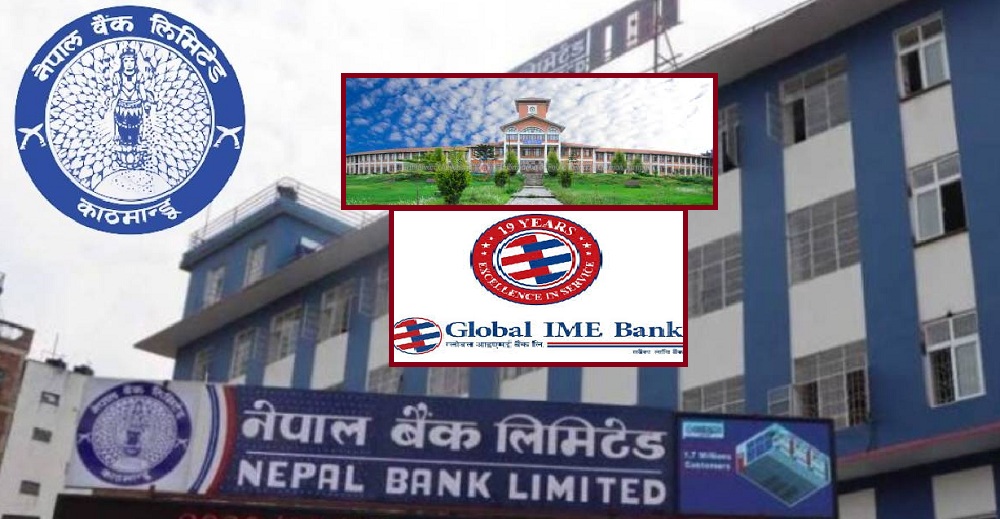
Allegations have surfaced that branch offices, parking areas and service structures of several banks were built on land reportedly owned by Tribhuvan University. Although the banks have not openly admitted to “encroaching” on university property, difficult questions are now being raised.
Did these institutions obtain formal legal permission from the university before establishing their structures? If approval was granted, where are the official records? And if no such permission existed, how were regulated financial institutions allowed to operate on public university land for years without scrutiny?
The controversy has placed Nepal’s banking sector in an uncomfortable position. Banks are traditionally viewed as symbols of transparency, legal compliance and institutional discipline. Allegations involving public land use could therefore damage public confidence at a time when the sector is already struggling with rising bad loans, weak investment activity and declining trust.
A Symptom of a Larger National Problem
Analysts say the Tribhuvan University land controversy is not an isolated incident but part of a much larger pattern seen across Nepal for decades.
Weak administrative oversight, poor land record management and political influence have frequently allowed public and government-owned land to gradually fall into the hands of powerful groups or institutions.
What makes this case particularly alarming is that even formal and regulated institutions appear to have become entangled in the controversy.
The incident has also exposed serious weaknesses within the university administration itself. Critics are asking why the university failed to properly monitor its property for decades, why records were not updated on time and why efforts to reclaim the land began only now.
Some observers describe the situation as a clear case of institutional negligence, while others believe political protection may have enabled the prolonged use of university property without accountability.
Educational Land Turned Into Commercial Space
Land owned by Tribhuvan University was intended to support educational expansion and academic development. However, the operation of commercial businesses, banking services and other non-academic structures on such land has now become a central point of concern.
Some former university officials suggest that temporary permissions granted years ago may have gradually evolved into permanent occupation. There are also suspicions that some land may have been indirectly used through local clubs, organizations or municipal arrangements.
However, legal experts caution that the full truth will emerge only after detailed investigation and verification of official records.
Institutions on Edge as TU Begins Recovery Campaign
Tribhuvan University has now reportedly begun formally contacting institutions using disputed land and asking them to provide clarification within a specified timeframe.
The university’s move has created anxiety among many organizations that may be affected by future legal action. If investigations confirm that land was occupied or used without proper legal procedures, the dispute could escalate into lengthy court battles.
A Test of Nepal’s Institutional Credibility
Beyond the land dispute itself, the controversy has sparked a larger national debate: who is actually responsible for protecting public property in Nepal?
If even the assets of the country’s most important public university cannot remain secure, questions naturally arise about the condition of other government and public properties across the nation.
The Tribhuvan University land controversy is no longer merely an administrative issue. It has evolved into a major test of public accountability, governance and institutional integrity.
How the investigation proceeds in the coming months — whether independently and transparently or under political and institutional pressure — could significantly shape public trust in Nepal’s administrative system and the rule of law.