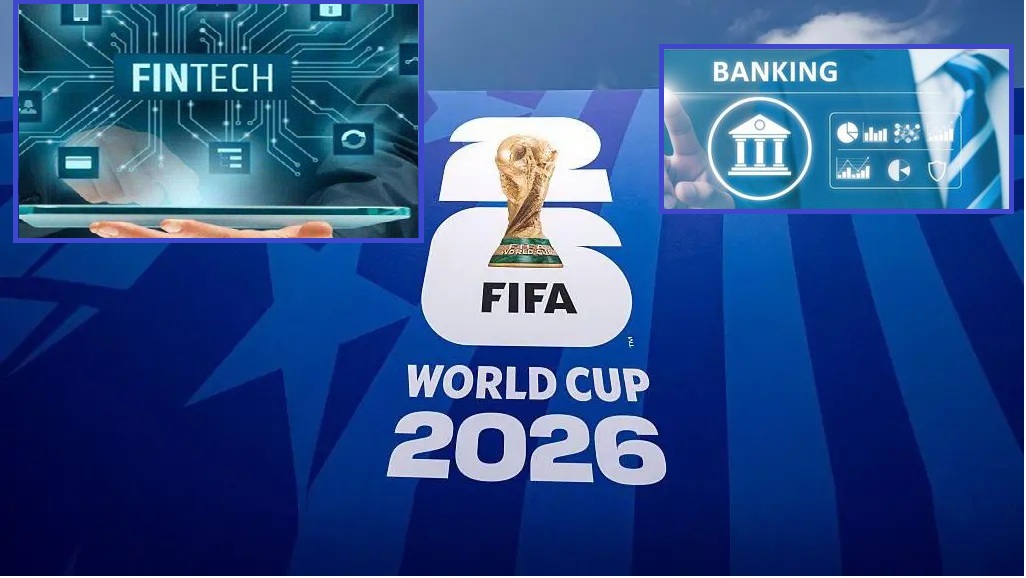
 Banking Khabar / On the football field, players compete for goals. But beyond the pitch, another intense competition is underway one for global brand dominance. In this arena, the banking and fintech sectors have become increasingly active in recent years.
The FIFA World Cup, one of the world’s largest sporting events, is no longer just a stage for watching football. It has evolved into a massive global platform for business, technology, digital services, and financial institutions seeking to expand their influence. With hundreds of millions of viewers worldwide, banks and fintech companies are leveraging the tournament to showcase their services, technology, and credibility to international audiences.
The growing partnership between the banking sector and the FIFA World Cup 2026 reflects this transformation. Major global financial institutions are now shifting away from traditional advertising strategies and instead building their brands through sports-driven engagement, digital experiences, and lifestyle integration.
Banking Redefined: From Money Management to Experience Creation
Decades ago, a bank’s identity was measured by its branch network, deposits, and lending portfolio. For customers, a bank was simply a place to store money, access loans, and conduct financial transactions.
But in the digital era, banking has fundamentally changed. Today, banks aim to become digital partners in everyday life. Mobile banking, digital wallets, instant payment systems, artificial intelligence (AI)-based services, and advanced data analytics have reshaped the entire banking experience.
In this context, global banks are increasingly turning to emotionally powerful platforms like sports to build international recognition. Football, which unites people through shared emotion, offers a unique opportunity for banks to connect their brands with global audiences.
Bank of America and the Rise of Global Banking Partnerships
Bank of America has become an official banking partner for the FIFA World Cup 2026. This is not just a sponsorship deal—it is widely viewed as a strategic move to expand global customer reach.
For banks, participation in events like the World Cup offers access to millions, even billions, of potential customers. In major markets such as the United States, where the tournament will be held, financial institutions gain a powerful platform to expand digital services, enhance customer experience, and strengthen brand identity.
Banking competition is no longer limited to financial performance indicators alone. Brand influence and emotional connection with customers have become equally important.
Fintech’s Rising Power: From Payments to Smart Experiences
Fintech is another major force shaping the World Cup ecosystem. Modern sporting events rely heavily on digital infrastructure—from ticket purchases and stadium transactions to online content access, travel services, and cross-border payments.
As a result, global fintech companies are increasingly aligning with major sporting events to demonstrate their technological capabilities. Fintech has transformed banking from physical branches into mobile-first financial ecosystems, bringing services directly into the hands of users.
Football and Finance: A Shared Foundation of Trust
Football and banking share a core similarity: both are built on trust. Fans trust their teams, and customers trust financial institutions with their money and future.
By associating with global sporting events, banks aim to reinforce this trust. Being linked to the world’s biggest tournament sends a psychological message of strength, scale, and international credibility.
Data, AI, and the New Digital Financial Era
Events like the FIFA World Cup generate massive volumes of data—ranging from consumer behavior and digital transactions to user preferences and engagement patterns. This data has become highly valuable for modern financial systems.
Banks are increasingly relying on AI and data analytics for customer insights, risk assessment, personalized services, and fraud detection. In this sense, the relationship between sports and financial technology extends far beyond marketing, it is shaping the foundation of the future digital economy. Mobile banking, QR payments, digital wallets, and online financial services are rapidly transforming customer behavior. However, building a global brand requires more than technology; it demands trust, innovation, security, and customer experience.
The Future of Banking: A Borderless Digital Brand
The evolving strategy of banks and fintech companies around the FIFA World Cup highlights a major shift in the financial industry. The future of banking will no longer be limited to deposits, loans, and transactions.
Instead, it will be defined by technology, experience, global branding, and emotional engagement. Football brings the world together on one field, while banking and fintech connect that unity to the digital economy. Global sporting events are no longer just advertising platforms for financial institutions—they are stages for demonstrating capability, innovation, and trustworthiness.
In the coming years, the most successful banks will be those that offer not only financial services but also world-class digital experiences. This transformation is pushing banking and fintech firms from regional players toward truly global digital brands.