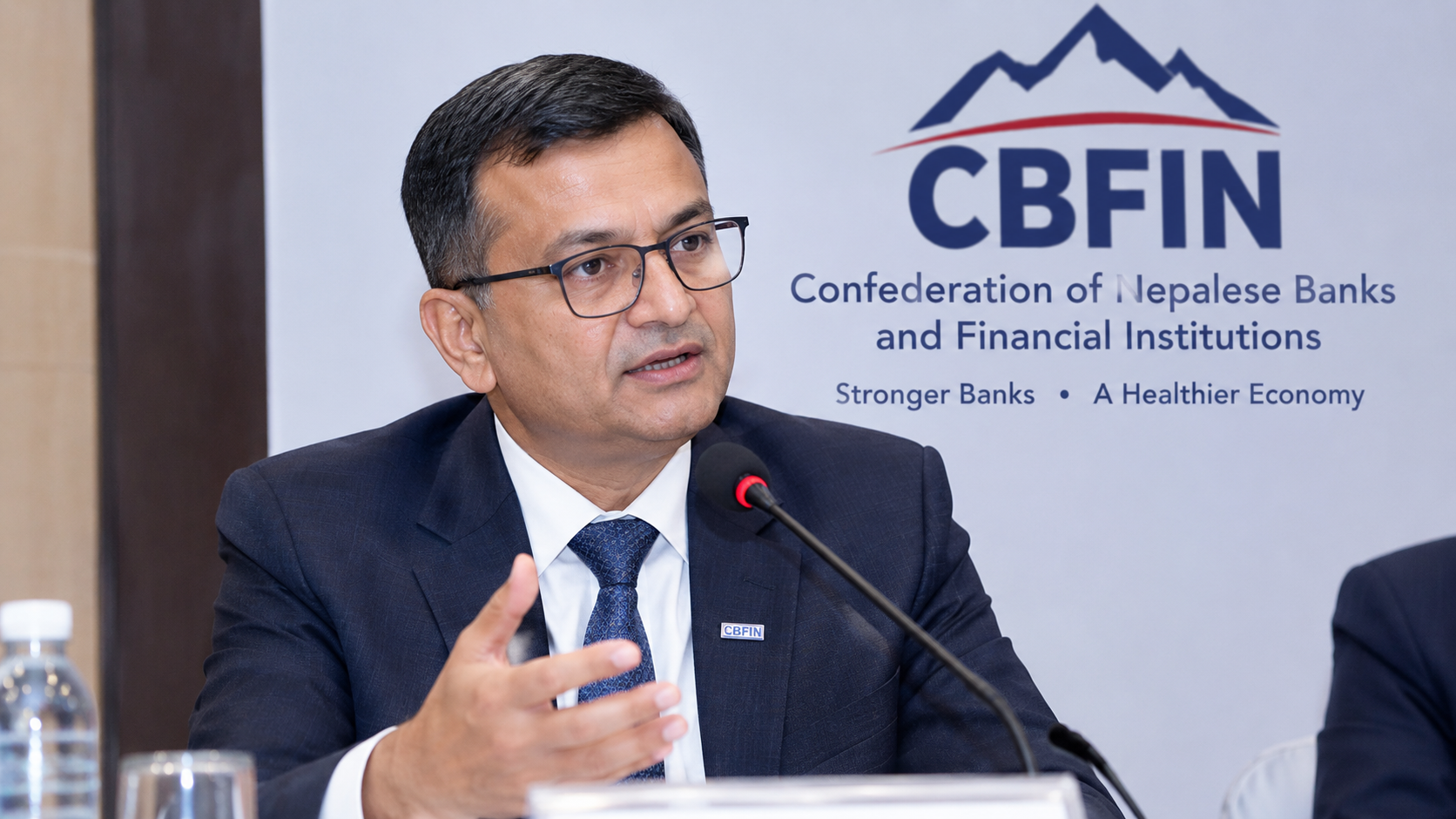
Banking Khabar/ Nepal’s Confederation of Banks and Financial Institutions (CBFIN) has urged policymakers to strengthen confidence in the banking system through targeted policy reforms, warning that negative public commentary and poorly calibrated regulatory decisions could undermine financial stability.
CBFIN President Rajesh Upadhyay said the pressures facing the banking sector should not be interpreted as a long-term crisis. The sector has been affected by a slowdown in economic activity, weaker investment sentiment and recent natural disasters, but the situation can be improved through appropriate policy intervention, he said.
Speaking at a press interaction in Kathmandu, Upadhyay said banks and financial institutions remain a central channel for mobilising capital in the economy and that decisions affecting the sector should take into account its sensitivity and wider economic impact.
“Depositor confidence is the foundation of banking,” Upadhyay said, stressing that even a financially sound institution could face immediate pressure if depositors lost confidence and began withdrawing funds.
He called for greater responsibility in public statements about banks and financial institutions, particularly as negative comments from politicians, businesspeople and other public platforms have increased in recent times.
Regulatory action, changes to banking rules and other policy decisions should be assessed not only on their immediate objectives but also for their potential impact on the wider banking system, he said.
Investment confidence remains key
CBFIN said restoring private-sector and investor confidence would be critical to reviving economic activity.
Upadhyay said policy stability, clear enforcement of laws, confidence in investment returns and a predictable business environment were necessary to attract new investment. A stronger investment climate could allow economic activity to expand despite limited resources, while policy uncertainty and fear could discourage investment even where economic opportunities exist.
He also pointed to the expansion of private-sector banks and financial institutions as an important contributor to economic activity and called for closer cooperation between the banking industry and the private sector to help overcome the current slowdown.
Call to review credit-risk policies
CBFIN has also called for changes to several existing regulatory provisions affecting banks and financial institutions.
Upadhyay said rules covering the qualifications and age limits of bank directors, as well as penalties for ordinary or minor shortcomings, should be made clearer and more practical.
He also called for a review of the additional tax burden associated with loan-loss provisions exceeding 5% at a time when weak economic activity is increasing credit risks.
Such costs should not be viewed as a burden on banks alone, Upadhyay said, arguing that their eventual impact could extend to depositors and the broader public.
CBFIN also wants the government to accelerate the establishment of the proposed Asset Management Company to deal with the rising volume of non-banking assets and distressed assets held by banks and financial institutions.
Upadhyay urged the government to complete the establishment process by the end of Poush.
Restructuring sought for disaster-hit borrowers
The banking industry has also called for relief measures for borrowers whose businesses and properties were damaged by recent floods and landslides.
Upadhyay said borrowers genuinely affected by the disasters should be assessed on an individual basis and provided with appropriate repayment relief.
He proposed coordination between Nepal Rastra Bank and banks and financial institutions to address such cases through loan restructuring and rescheduling.
At the same time, he said deposits held by the public in banks and financial institutions remain safe and urged stakeholders to avoid actions or statements that could generate unnecessary doubts about the financial system.
CBFIN urges productive use of remittances
Upadhyay said remittances earned by Nepalis working abroad have become a major pillar of the country’s economy, but argued that more of the funds should be channelled into domestic investment, production and job creation rather than consumption alone.
Nepal still has significant economic potential, he said, calling for an economic environment built around confidence, stability and cooperation rather than excessive controls.
Upadhyay said the pressures currently affecting the banking sector remain manageable if the government, regulators, banks and financial institutions, and the private sector work together.
Effective coordination among these stakeholders, he said, could help restore momentum in both the financial system and the broader economy.