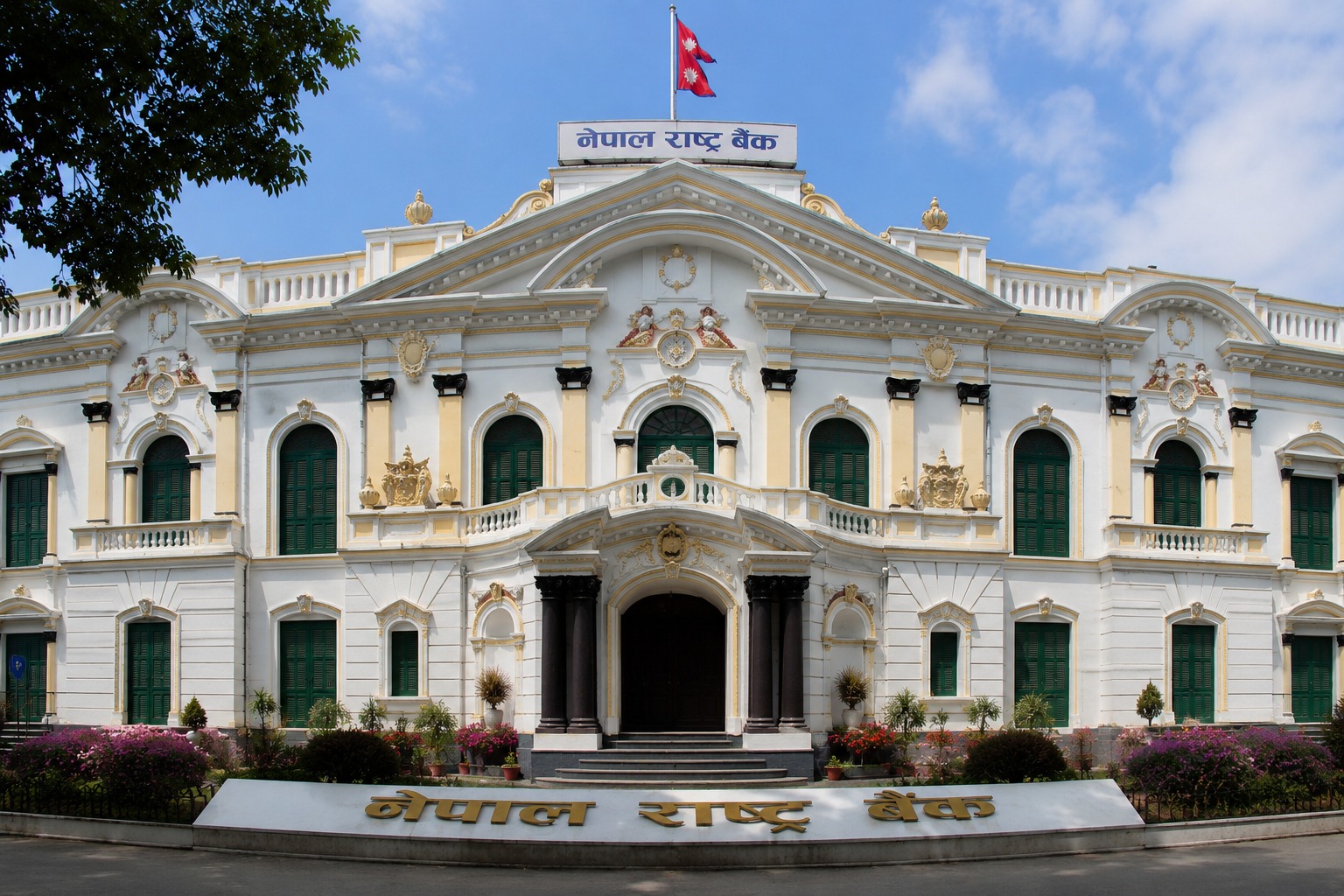
 Banking Khabar/ The total assets and liabilities of Nepal Rastra Bank (NRB) have crossed Rs 4 trillion. According to the central bank’s preliminary financial statement for the end of Bhadra, the total balance sheet of Nepal Rastra Bank has reached Rs 4 trillion 44 billion 7 million 99 thousand.
At the end of last Asar, the central bank’s total assets and liabilities stood at Rs 3 trillion 874 billion 98 million 89 thousand. This means the balance sheet increased by around Rs 169 billion over the two-month period.
Foreign currency-denominated assets account for the largest share of the central bank’s total assets. By the end of Bhadra, such assets had reached Rs 3 trillion 899 billion 78 million 55 thousand. This means that more than 96 percent of Nepal Rastra Bank’s total assets are concentrated in foreign currency-based assets.
A significant portion of these foreign currency assets has been invested in foreign securities. As of the end of Bhadra, Nepal Rastra Bank had invested Rs 2 trillion 743 billion 30 million in foreign securities. Similarly, fixed-term deposits held with foreign banks stood at Rs 639 billion 74 million.
The central bank also held Rs 244 billion 30 million in cash and balances with foreign banks. Its investment in gold certificates stood at Rs 253 billion 97 million. Assets related to the International Monetary Fund (IMF) amounted to Rs 18 billion 44 million.
How Much Does Nepal Rastra Bank Hold in Local Currency Assets?
Compared with its foreign currency-based assets, Nepal Rastra Bank’s assets denominated in local currency are significantly smaller. By the end of Bhadra, total local-currency assets stood at Rs 144 billion 29 million.
Of this amount, Rs 91 billion 67 million was held in gold and silver, while Rs 11 billion 64 million was invested in government securities. A further Rs 12 billion 41 million was held in bonds and fixed-term deposits.
The financial statement shows that foreign assets have a dominant position in the balance sheet of Nepal’s central bank. In particular, investments in foreign securities, deposits with foreign banks and gold-related assets made for the management of foreign exchange reserves appear to have played a major role in increasing the overall size of the balance sheet.
Currency in Circulation Declines
Despite the increase in the central bank’s overall balance sheet, currency in circulation declined slightly by the end of Bhadra. According to the financial statement, currency in circulation fell to Rs 794 billion 2 million.
Compared with the end of Asar, currency in circulation decreased by around Rs 7.62 billion. Meanwhile, the central bank’s reserves increased to Rs 1 trillion 110 billion 20 million 96 thousand.
Government deposits also increased to Rs 301 billion 20 million.
Thus, Nepal Rastra Bank’s financial statement for the end of Bhadra shows that its total balance sheet has not only crossed the Rs 4 trillion mark, but that the overwhelming majority of its assets are concentrated in foreign currency-based assets. Investments in foreign securities and deposits with foreign banks have emerged as the key components of the central bank’s asset structure.