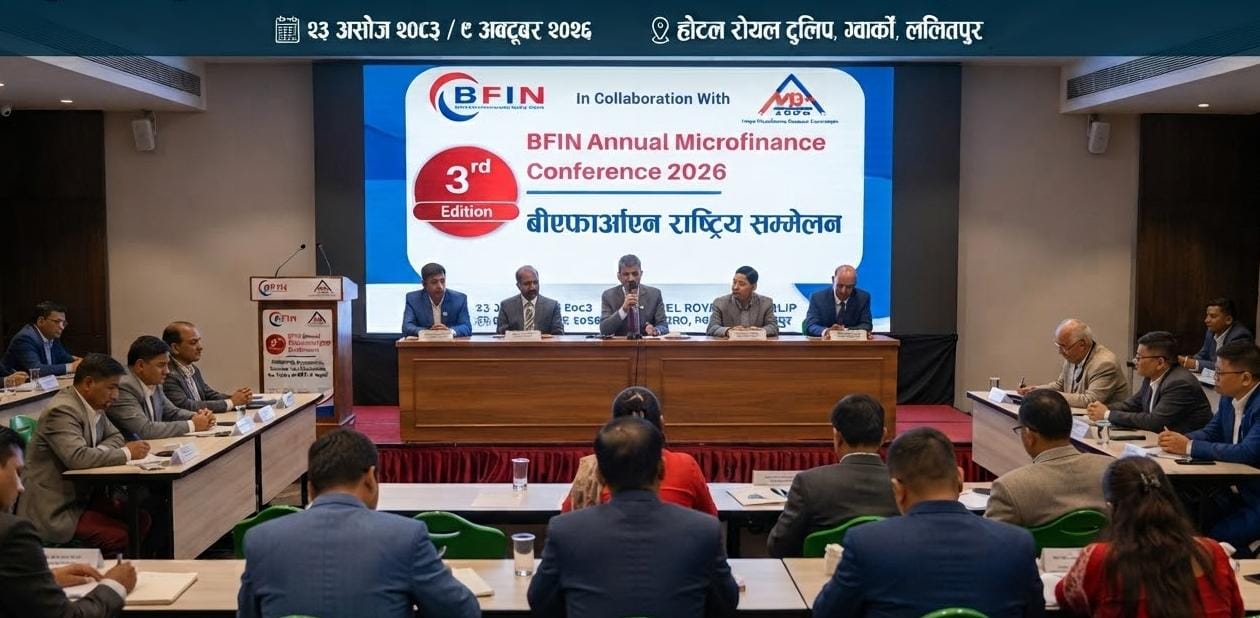
Banking Khabar / The third BFIN Annual Microfinance Conference 2026 is being held today, Friday, October 9, in Lalitpur to discuss the challenges facing Nepal’s microfinance sector, ways to improve loan quality, and measures to ensure institutional sustainability. The conference is being organized in collaboration with the Banking Finance and Insurance Institute of Nepal Limited (BFIN) and the Nepal Microfinance Bankers Association (NMBA) at Hotel Royal Tulip in Gwarko, Lalitpur.
The conference will bring together directors and senior executives of microfinance institutions, representatives of regulatory bodies, and financial sector experts. Its primary objectives are to identify the challenges facing microfinance institutions, improve loan recovery, and explore ways to make financial services more effective.
Discussions on Loan Quality and Borrower Challenges
Nepal’s microfinance sector has played an important role in expanding financial access among rural and low-income communities. However, difficulties in loan recovery, borrowers’ repayment capacity, the practice of borrowing from multiple institutions, and the financial condition of microfinance institutions have emerged as major challenges for the sector.
The conference will discuss measures to improve loan quality, strengthen risk management, protect customers, and maintain financial discipline. Issues such as loan restructuring, improving operational efficiency, and managing potential credit losses will also be included in the discussions.
As microfinance institutions are expected to fulfil their social objectives while remaining financially sustainable, maintaining a balance between credit expansion and risk control has become increasingly important.
Digital Technology and AI in Microfinance
The conference will also examine how digital technology and artificial intelligence (AI) can be used to improve microfinance services. Technology has the potential to help identify customer needs, assess credit risks, and make service delivery more efficient.
However, the expansion of digital services can also increase risks related to cybercrime, online fraud, and the security of customers’ personal and financial information. A dedicated session will address these concerns. According to the organizers, representatives of the Nepal Police Cyber Bureau and technology experts will discuss financial crime risks and measures to strengthen security.
Learning from Bangladesh’s Experience
A special session at the conference will explore lessons Nepal can learn from Bangladesh’s more than four decades of experience in microfinance. A. K. M. Sazzad Hossain, Deputy General Manager of Grameen Bank in Dhaka, Bangladesh, will participate in the session.
The discussion will focus on women’s access to finance, the development of women-led entrepreneurship, and practices for expanding financial services through microfinance. The objective is to identify useful lessons for Nepal from Bangladesh’s successful practices as well as the challenges it has faced.
New Financial Services Also on the Agenda
The conference will also explore opportunities to expand financial services beyond traditional microcredit. Discussions will cover rural enterprise development, agricultural and climate finance, microinsurance, affordable housing, education loans, and business diversification.
In addition, a special discussion will examine the current state of Nepal’s microfinance sector, the regulatory framework, and priorities for future reforms. Loan quality, institutional financial health, customer protection, and responsible credit expansion will be considered key elements of the sector’s long-term development.
The conference will facilitate the exchange of experiences among regulators, microfinance institutions, financial sector experts, and international representatives. The organizers expect that the recommendations emerging from the discussions will help identify existing challenges and establish priorities for future reforms in Nepal’s microfinance sector.