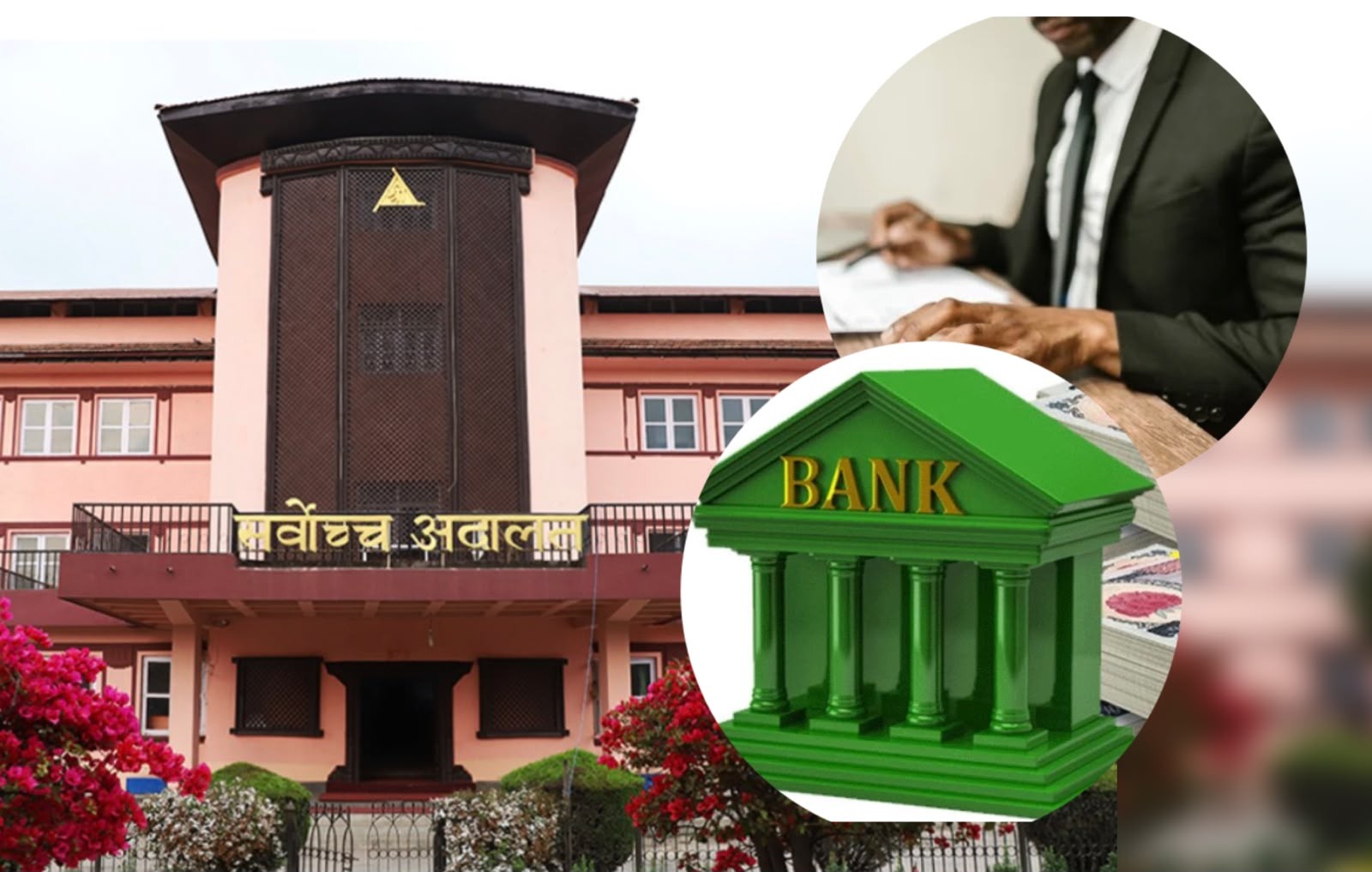
Banking Khabar / The Supreme Court’s recent interpretation that borrowers may face criminal proceedings for using bank loans for purposes other than those specified at the time of borrowing—even when they are regularly repaying principal, interest, and instalments—has created a stir in Nepal’s banking and financial sector. Following the publication of the full text of the verdict, bank directors, bankers, and private-sector businesspeople have expressed growing concern and uncertainty over its potential implications.
A joint bench of the Supreme Court interpreted that using a loan for a purpose other than the one for which it was approved may constitute grounds for investigation and criminal proceedings under the Banking Offence and Punishment Act, 2006. Previously, in many cases involving the use of loans for purposes other than those approved, the matter was generally addressed through the business relationship between banks and borrowers, loan recovery measures, and regulatory actions. The latest interpretation, however, has clarified the possibility of bringing such activities within the scope of criminal investigation as well.
The verdict was issued on August 14, 2026, by a joint bench of Justices Tek Prasad Dhungana and Megh Raj Pokharel in response to a habeas corpus petition filed by Muna Chhetri on behalf of Shashidhar Sharma, a businessman from Rupandehi, who had borrowed from Prabhu Bank.
Sharma had obtained a loan of NPR 480 million from Prabhu Bank for the stated purpose of purchasing land for resort construction. During a special on-site inspection by Nepal Rastra Bank, the funds were found not to have been used for the approved purpose and had instead been transferred through the accounts of various individuals and institutions. Following these findings, an investigation was initiated.
The Supreme Court ruled that the use of loan funds for purposes other than those approved can be investigated even if repayments are being made regularly. However, the court also clarified that borrowers do not automatically become guilty simply because loan funds were used elsewhere. A factual investigation and judicial examination are necessary to establish whether an offence has actually occurred.
The interpretation has raised three major questions in the banking sector: What will happen to loans disbursed in the past? Could all borrowers who changed the purpose of their loans come under investigation? And what impact could the implementation of this interpretation have on the banking system and private-sector investment?
How Could Reopening Past Loans Affect the Banking Sector?
In Nepal’s banking sector, the practice of borrowing for one stated purpose and using the funds in another business or sector has reportedly existed for years. This is particularly relevant among large business groups, where several companies operate under the same corporate umbrella. In some cases, a company may use a loan obtained by another company within the group for business operations, project financing, or the management of financial obligations.
In certain situations, the use of funds may have changed because of business requirements, market conditions, or project developments. In other cases, funds may have been diverted without informing the bank or obtaining its approval. Therefore, all such situations cannot be treated as identical cases of loan misuse.
Santosh Koirala, President of the Nepal Bankers’ Association, has stated that many loans disbursed before the introduction of the Working Capital Loan Guidelines were used for purposes different from those originally approved, and a substantial amount of such funds remains invested. He has expressed concern that if these older loans are also affected by the latest interpretation, the financial sector could face a major crisis.
Similarly, Rajesh Upadhyay, Acting President of the Banking and Financial Institutions Confederation of Nepal, has argued that loan misuse could be addressed through loan recovery, repayment arrangements, and regulatory measures such as provisioning, rather than escalating every such matter to criminal proceedings.
This indicates that the banking sector’s concerns extend beyond a single court verdict. They are also linked to the status of loans disbursed in the past and the potential legal risks that may arise in the future.
Even Borrowers Making Regular Repayments Could Face Investigation
Until now, many borrowers have assumed that regularly paying principal and interest means they are fulfilling their financial obligations to the bank. However, the Supreme Court’s latest interpretation makes it clear that regular repayment does not automatically provide immunity from investigation if loan funds have been used for purposes other than those approved.
This creates the possibility that even borrowers who are paying their instalments on time could face investigation over how they used the borrowed funds. Nevertheless, being investigated and being proven guilty are two different matters. The reasons behind the diversion of funds, the borrower’s intention, the nature of the transactions, and the available evidence must all be examined through the judicial process.
For businesspeople, the central uncertainty is how authorities will distinguish between changes in investment arising from changing business circumstances and deliberate misuse of loans intended to deceive banks.
Loan Practices of Large Business Houses Also Under Scrutiny
In Nepal, it is common for large business groups to operate multiple companies under a single corporate structure. A company may obtain a bank loan and invest the funds in another company, manage the financial obligations of other group entities, or channel the money into a new project.
In such transactions, the company receiving the loan, the company receiving the funds, and the sector in which the final investment is made may be different. Whether the bank’s prior approval and the loan agreement permit such transactions could therefore become a decisive factor.
If funds have been deliberately diverted without the bank’s approval, legal questions may arise. However, every transaction within a business group cannot automatically be treated as a criminal offence. An examination of the purpose of the transaction, the loan agreement, the bank’s approval, and the actual economic activities involved is necessary.
The latest verdict therefore highlights the need for greater scrutiny and legal examination of loan utilisation practices among large business groups as well.
Banks Also Have Significant Responsibilities
Banks and financial institutions are also responsible for monitoring whether loans are being used for the purposes for which they were approved. Section 55 of the Banks and Financial Institutions Act, 2017, requires loans to be disbursed for specified purposes. Section 56 requires regular monitoring of loan utilisation, while Section 57 provides for loan recovery through collateral in cases of loan misuse.
This means that when a loan is used for a purpose other than the one approved, questions arise not only about the borrower’s conduct but also about the effectiveness of the bank’s monitoring system.
Did the bank properly assess the project before approving the loan? Did it monitor where the funds were being spent? Was the bank aware that the money had been diverted? Had the bank itself given consent or approval for the change in the use of funds? These questions also need to be addressed.
The role of bank management and monitoring systems becomes even more important if a bank knew that loan funds were being used elsewhere but allowed the practice to continue.
Is It Possible to Investigate All Past Loans?
Examining the stated purposes and actual utilisation of every loan previously disbursed by Nepal’s banks and financial institutions would be a massive undertaking. It would require reviewing loan files, disbursement records, borrowers’ transactions, accounts through which funds were transferred, and the actual status of the projects concerned.
The business circumstances at the time a loan was approved may also differ significantly from the present situation. Some projects may still be operational, others may have been shut down, while some borrowers may have already repaid their loans in full.
Therefore, the practicality and legal basis of investigating all past loans under a single approach require clarification. In particular, applicable legal limitation periods, the nature of the alleged offences, and the availability of evidence in older cases will be important considerations.
Risk of Further Contraction in Credit Flow
Although Nepal’s banking sector currently has ample liquidity, credit demand has not increased as expected. Despite low interest rates, private-sector investment and credit expansion have yet to gain the anticipated momentum.
In this situation, if banks and borrowers perceive greater risks of criminal investigation in cases involving changes in loan utilisation, both sides may become more cautious. Banks could impose stricter conditions before disbursing loans and closely monitor the use of funds, while businesspeople may hesitate to borrow for new investments.
This could affect plans for new industries, projects, and business expansion. On the other hand, controlling loan misuse and maintaining discipline in the banking system are also essential for long-term financial stability.
Nepal Rastra Bank Needs to Provide Clarity
Following the Supreme Court’s latest interpretation, the role of Nepal Rastra Bank has also become important. Clarity is needed on the regulatory practices previously followed by the central bank in cases where loan utilisation changed, as well as how such loans should be examined going forward.
The regulator needs to provide clear guidance on the distinction between loan misuse and changes in the use of funds arising from business circumstances, the status of transactions carried out with bank approval, the examination of past loans, and the priorities for investigation.
Controlling loan misuse is necessary. Deliberate diversion of bank loans and attempts to deceive financial institutions must be brought within the scope of the law. However, ordinary changes in business decisions, transactions carried out with bank approval, and deliberate loan misuse should not all be treated in the same way.
The Supreme Court’s verdict has placed greater emphasis on discipline in the use of bank loans. How this interpretation is implemented in practice will determine the future direction of both the banking sector and the private sector.
The central question is no longer whether those who misuse loans should be held accountable. Rather, it is how authorities will distinguish deliberate loan diversion from ordinary business transactions. If this distinction is not clearly established, a legal interpretation intended to strengthen credit discipline could create further uncertainty among banks, borrowers, and the private sector.