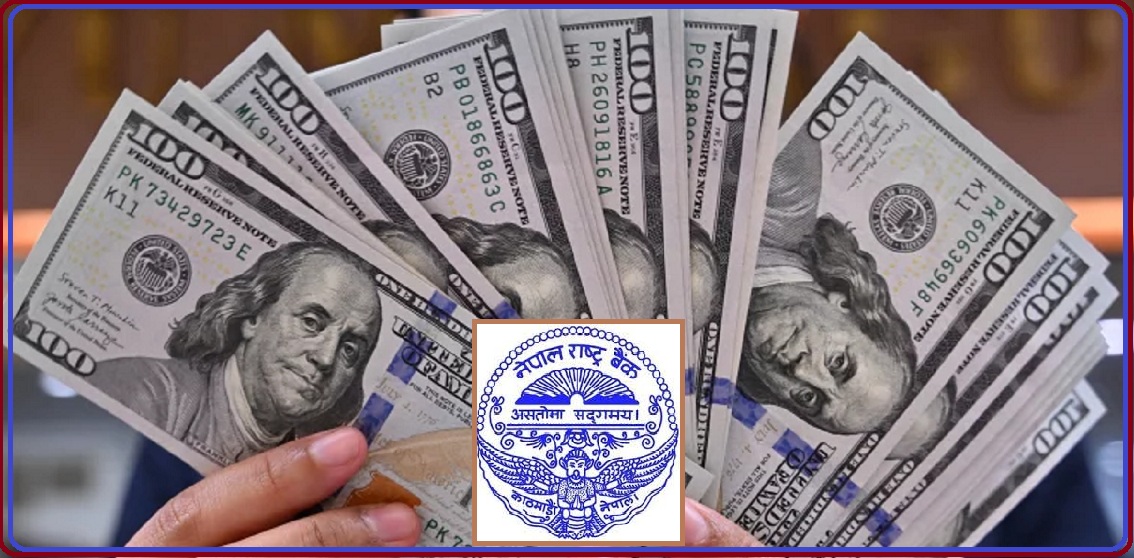
 Banking Khabar / Nepali citizens can now legally keep up to USD 1,500 in cash, according to a recent notice issued by Nepal Rastra Bank.
Nepal’s Growing Dependence on the U.S. Dollar Raises Economic Concerns
Nepali citizens can now legally keep up to USD 1,500 in cash, according to a recent notice issued by Nepal Rastra Bank. The amount may include money brought from abroad or savings left after foreign travel. However, the central bank has stated that any amount exceeding USD 1,500 must be exchanged within 35 days.
The announcement comes at a time when the role of the U.S. dollar in Nepal’s economy is becoming increasingly significant. Over the past few years, dollar transactions and demand have risen sharply due to Nepal’s import-based economy, remittance inflows, tourism, foreign aid, and international trade.
Although the Nepali rupee is pegged to the Indian rupee under a fixed exchange rate system, fluctuations in the U.S. dollar continue to directly impact Nepal’s economy. As a result, the dollar has become one of the most closely watched indicators in the country’s financial system.
Dollar Flow Driven by Remittance and Trade
Foreign exchange transactions in Nepal are primarily regulated by Nepal Rastra Bank through its Foreign Exchange Management Department, which oversees exchange rates, currency approvals, and overall foreign exchange management.
In Nepal, U.S. dollars mainly circulate through banks and financial institutions, money exchange companies, and remittance systems. Every day, thousands of Nepali migrant workers send money home from countries including the United States, South Korea, Japan, Middle Eastern nations, and European countries. These remittance inflows play a vital role in strengthening Nepal’s foreign exchange reserves.
The central bank publishes daily foreign exchange rates, and in recent months the U.S. dollar has generally traded between NPR 136 and NPR 141. A few days ago, the buying rate for one U.S. dollar was fixed at NPR 138.28, while the selling rate stood at NPR 138.88.
Stronger Dollar Increases Inflation Pressure
A rising dollar creates serious challenges for Nepal’s economy. Since Nepal imports petroleum products, medicines, electronics, machinery, and most consumer goods, a stronger dollar makes imports more expensive and increases inflationary pressure in the domestic market.
Fuel prices are particularly sensitive to dollar fluctuations because petroleum imports must be paid in U.S. currency. Higher fuel costs eventually impact transportation, industrial production, and everyday household expenses.
At the same time, a stronger dollar also provides some benefits. Families receiving remittances from abroad receive more Nepali rupees when exchanging dollars, increasing purchasing power and spending capacity, particularly in rural areas. Economists therefore view the impact of dollar appreciation as mixed for Nepal’s economy.
Foreign Debt Burden Rising
Nepal’s growing dependence on foreign loans has further increased the importance of the U.S. dollar. A significant portion of Nepal’s external debt is denominated in dollars, meaning that when the dollar strengthens against the Nepali rupee, the cost of repaying foreign debt automatically rises.
This has become a major concern for policymakers and economists, as increasing debt repayment costs place additional pressure on government finances and budget management.
In recent years, Nepal has accepted financial assistance and loans worth millions of dollars from institutions such as the World Bank and the Asian Development Bank. While these loans support infrastructure and development projects, they also deepen Nepal’s exposure to dollar fluctuations.
Hundi System Remains a Major Challenge
Another challenge linked to dollar circulation is the continued operation of the informal “hundi” system. These unofficial money transfer channels operate outside the formal banking system and weaken the central bank’s ability to manage foreign exchange reserves effectively.
Although authorities periodically intensify monitoring and enforcement against illegal hundi transactions, the practice continues due to foreign employment patterns and informal financial networks.
Digital Dollar Transactions Expanding
The nature of dollar transactions in Nepal is also evolving with the rapid expansion of digital banking and international payment systems.
Nepali banks have increasingly introduced dollar cards, prepaid international cards, and online payment services. Dollar-based transactions are becoming more common among students studying abroad, online entrepreneurs, freelancers, and tourism businesses.
Experts say Nepal must now focus on expanding exports, promoting tourism, attracting foreign investment, and increasing production-oriented industries to ensure long-term economic stability.
Analysts warn that if Nepal fails to strengthen its dollar-earning sectors, the country’s dependence on foreign currency could increase even further due to its import-heavy economic structure.
Dollar Now a Key Indicator of Nepal’s Economy
Today, the U.S. dollar is no longer just a foreign currency in Nepal. It has become a sensitive indicator of the country’s overall economic health.
Fluctuations in the dollar affect inflation, banking, trade, imports, remittances, foreign debt, and government spending. For this reason, economists say the management of dollar transactions and foreign exchange reserves is now directly tied to Nepal’s economic stability and future growth.