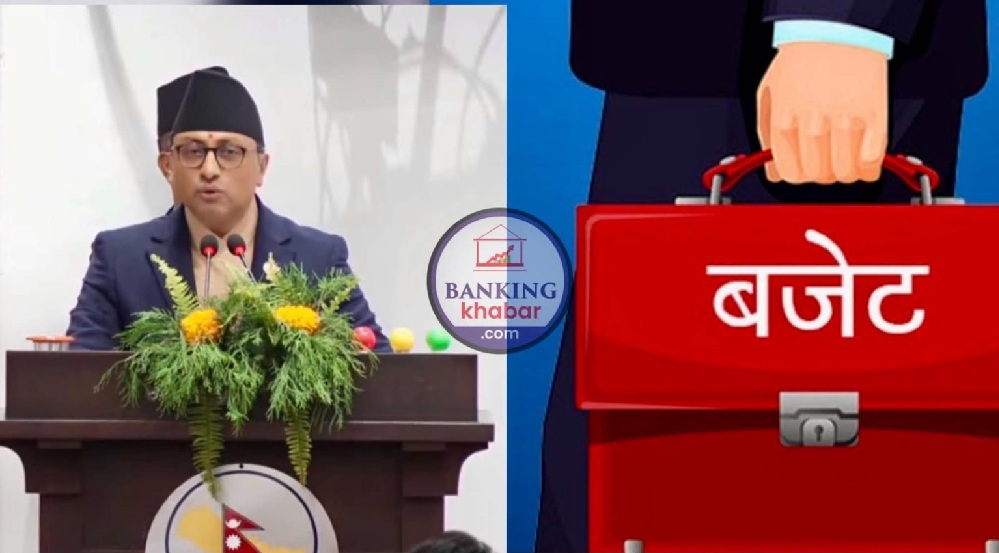
 Banking Khabar / The budget unveiled by the Government of Nepal for Fiscal Year 2083/84 is more than just an annual financial statement. It represents an attempt to revive economic momentum, restore investor confidence, stimulate private sector participation, and address structural weaknesses that have constrained growth in recent years.
At a time when economic activity has remained subdued, private investment has slowed, credit demand has weakened despite ample liquidity in the banking system, and a growing number of young Nepalis continue to seek opportunities abroad, the new budget arrives with promises of reform and renewed optimism.
One of the most significant aspects of the budget is its emphasis on investment-led growth. The government has prioritized productive sectors such as agriculture, industry, tourism, energy, and information technology. This signals a gradual shift from a consumption-driven economy toward a more production-oriented economic structure capable of generating sustainable growth and employment.
The budget’s capital market reforms stand out as one of its most ambitious initiatives. Plans to restructure the stock exchange, introduce intraday trading, short selling, derivative instruments, and facilitate greater participation by Non-Resident Nepalis have the potential to transform Nepal’s capital market landscape. If implemented effectively, these reforms could improve liquidity, attract institutional investors, deepen market participation, and enhance overall market efficiency.
The banking and financial sector also appears poised to benefit. Increased investment in infrastructure projects, business expansion, and entrepreneurship could stimulate credit demand and improve asset utilization within the financial system. For banks currently holding excess liquidity, the budget may create new lending opportunities and support stronger financial intermediation.
Another promising dimension is the focus on digital transformation and the information technology sector. By promoting digital exports, technology-based employment, and innovation-driven enterprises, Nepal could position itself as a regional technology destination. Such a strategy could help retain skilled youth, diversify export earnings, and reduce dependence on traditional sectors.
The energy sector remains one of Nepal’s strongest long-term opportunities. Continued investment in hydropower generation, transmission infrastructure, and electricity exports could significantly strengthen foreign exchange earnings and accelerate industrial development. Energy has the potential to become one of Nepal’s most valuable export sectors in the coming decade.
Yet, the success of these ambitions will ultimately depend on implementation. Nepal’s history demonstrates that policy announcements often exceed execution capacity. Delays in public spending, bureaucratic inefficiencies, weak project management, and regulatory uncertainty continue to challenge development outcomes.
Therefore, the FY 2083/84 budget should be viewed as a document of opportunity. It has opened doors for investment, capital market modernization, financial sector expansion, digital innovation, and energy-led growth. However, transforming these opportunities into measurable economic achievements will require strong political commitment, institutional coordination, regulatory effectiveness, and disciplined execution.
The budget has painted an optimistic picture of Nepal’s future. Whether that vision becomes reality will depend not on the announcements themselves, but on the nation’s ability to implement them efficiently and consistently.